Iron condor strategy explained
Search focus: iron condor strategy · iron condor payoff · iron condor explained · short iron condor · iron condor for beginners
An iron condor is a defined-risk, usually neutral / range-bound options structure. You sell an out-of-the-money put spread below the market and an out-of-the-money call spread above the market, same expiration, for a net credit.
You want the underlying to stay between the two short strikes so both short options lose value. Profit is limited to the credit; loss is limited by the long options on each wing.
Structure (4 legs)
- Sell OTM put (higher put strike of the put wing)
- Buy further OTM put (lower put strike) — defines risk on the downside
- Sell OTM call (lower call strike of the call wing)
- Buy further OTM call (higher call strike) — defines risk on the upside
Payoff intuition
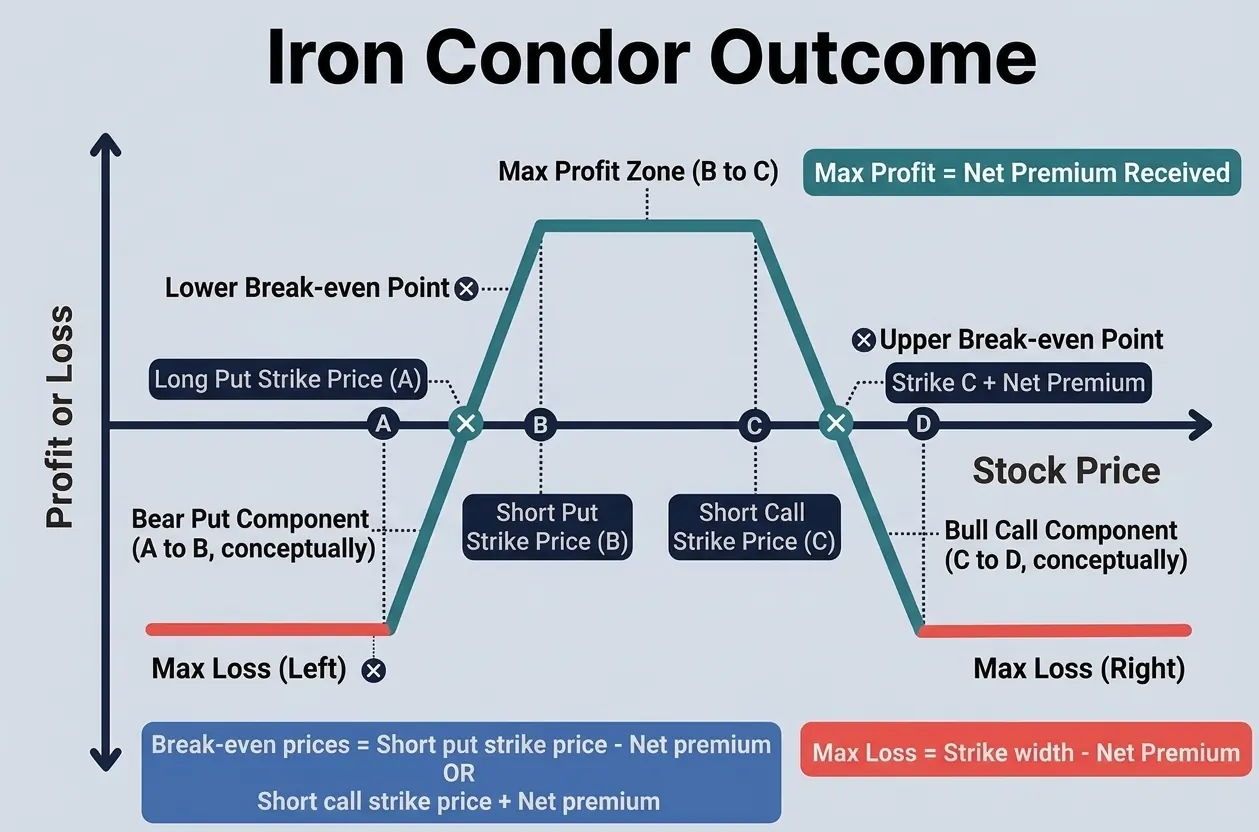
- Max profit ≈ net credit if price stays between the short put and short call
- Max loss ≈ width of the tested wing − credit
- Break-evens ≈ short put − credit (lower) and short call + credit (upper)
Choosing strikes and wing width
- Short strikes: many traders sell the put and call near 10–16 delta — far enough out to need a real move to be tested, close enough to pay real premium. Closer = more premium but easier to test; farther = safer but smaller credit.
- Wing width sets the max loss: width minus credit. A $5 wing with $1.50 credit risks $3.50 a side; a $10 wing with $2.00 credit risks $8.00. The credit grows slower than the risk as wings widen, so most traders keep wings modest.
- Expiry: 30–45 days is a common sweet spot — enough theta to work for you, not so much time that a trend builds against you. Near expiry, gamma risk rises and the position gets twitchy.
- All four legs share one expiry and one underlying. Mixing expirations turns it into a different structure (a diagonal) with different risk.
Worked example with numbers
ABC at $200. You sell a 30-day iron condor: sell the $190 put / buy the $185 put, sell the $210 call / buy the $215 call, for a net credit of $2.50 ($250 per contract).
- Max profit = $250, if ABC finishes between $190 and $210.
- Max loss = $5.00 − $2.50 = $250, if ABC finishes at or beyond $185 or $215.
- Break-evens: $190 − $2.50 = $187.50 and $210 + $2.50 = $212.50.
Between the break-evens you gain or lose a partial amount; outside them the loss is capped at $250. The worst case is known up front — that is what “defined risk” means.
Position management: when to adjust
- Take profits early: closing near ~50% of max profit is common. The last dollars of a credit spread carry outsized risk if the stock drifts toward a short strike.
- A tested wing: if the stock rallies toward the short call, some traders roll the put spread up for more credit or roll the whole condor out in time. Rolling the challenged call down usually means paying a debit for intrinsic value — often worse than closing.
- Set a loss limit before entry — e.g. close if the loss hits 2× the credit or a short strike is touched. Decide the rule when calm, not under fire.
- Earnings and assignment: the IV crush after announcements helps the condor, but a gap through a wing hurts far more — many traders avoid binary events. Deep ITM short options can also be assigned early, so keep buying power for that scenario.
Common iron condor mistakes
- Chasing a big credit with wide wings — the max loss grows faster than the credit.
- Holding to expiry for the “full credit” and getting pinned or assigned on a wing.
- Trading illiquid underlyings, where the bid–ask on four legs eats the edge.
- Reading “defined risk” as “low risk” — the max loss is several times the credit.
When it fits / when it does not
- Fits: you expect a quiet range; you want defined risk; you understand credit vs wing width
- Does not fit: you expect a big breakout; you cannot manage assignment or early tests of a wing; liquidity is poor
Open Iron Condor in Builder → Full Spreads lesson Strategies library
Beginner FAQ
What is an iron condor strategy?
An iron condor sells an out-of-the-money put spread and an out-of-the-money call spread, same expiration, for a net credit. You want the stock to stay in a range.
Is an iron condor defined risk?
Yes. Long options on each wing cap the loss. Max loss is about the tested wing width minus the credit.
When do traders use an iron condor?
When they expect a range-bound market and want defined risk. Large trends and volatility spikes can test a wing.
How wide should the wings be?
The wing width sets the max loss (width minus credit). Wider wings pay more credit but raise the worst case faster than the premium grows.
When should I close an iron condor?
A common approach is to close near ~50% of max profit rather than holding to expiry for the last dollars. Set a loss limit (e.g. 2× the credit) before entering.
Can an iron condor be assigned early?
Yes — American-style options can be assigned any time, especially a deep in-the-money short put near a dividend. Keep buying power for that scenario.
Next: Print the options cheat sheet or open this setup in the Builder.
Iron condor quiz
A range-bound, defined-risk credit structure.